In my experience, more than 90 percent of people who start lessons have no playing experience at all. Teaching beginner drummers has its own logic. A student who has already played for a while may come with very specific questions: muscle tension, a particular style, or materials for developing creativity. With beginners, the situation is different.
The first problem a beginner faces is not knowing where to start. There is so much drum content online that a person can easily get lost in it. Sometimes students come in saying they watched a few things, tried something on their own, and did not get much out of it. I actually like when people have already tried to dig into the subject themselves. Very often they turn out to be the most motivated students. They already understand that simple shortcuts, even when they exist, usually slow you down in the long run.
Coordination
For someone sitting behind a drum set for the first time, I believe the most important thing is to start developing coordination right away. Technique matters too, of course, but at the very beginning a basic understanding is enough. More detailed work with drum rudiments can come later, when the basic coordination is already more stable. Rebound, tap-down-up-full strokes, and the systems used by different authors are not where I usually start. After a few months, if I see that the student is practicing consistently, we can talk about those things in more detail.
At first, coordination is the priority. Learning drums is impossible without constantly developing it. A drummer may not have outstanding speed or advanced technique, but with solid coordination they can already sound much more interesting and musical. Music history is full of drummers who were never famous for speed, and speed is not even needed in every style. Still, their names are known around the world, and their contribution to music is respected even by highly technical players.
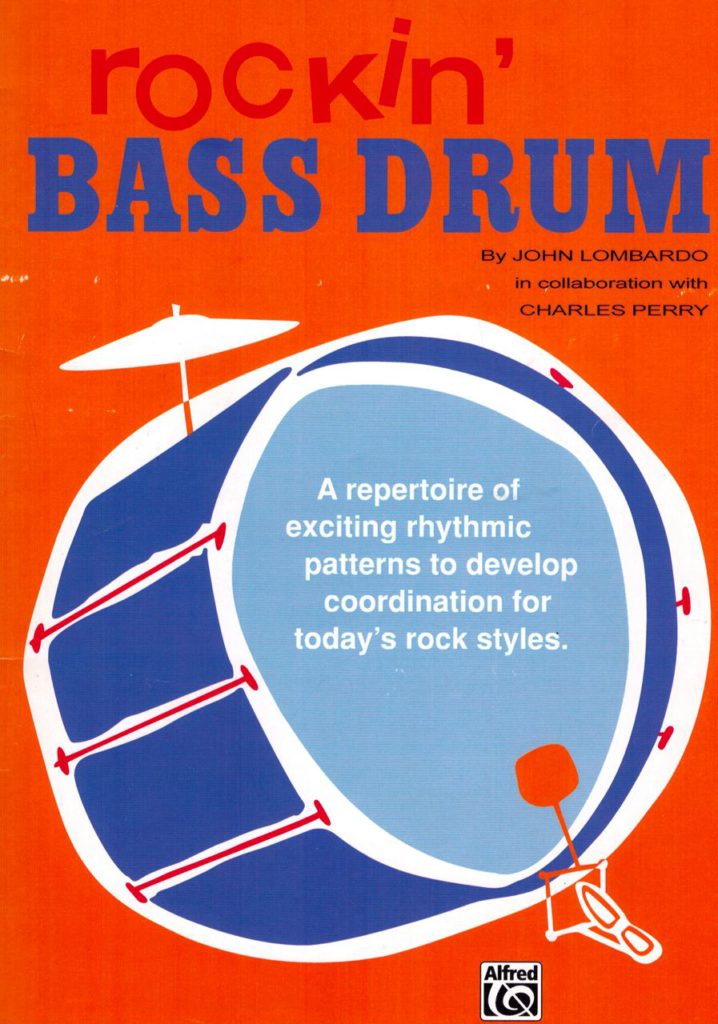
Beginner drum lessons should build basic coordination first. This is the level that allows a student to play rock patterns, for example from John Lombardo’s book Rockin’ The Bass Drum.
Later we can make the task more complex by adding a little funk feel through specific techniques. We can also touch on swing in its traditional sense. Jim Chapin’s Advanced Techniques For The Modern Drummer is excellent material for that.
Coordination work is a detailed and sometimes slow process. It does not always sound like music. Sometimes it is just an exercise that would not really fit under a song. But these exercises develop freedom of movement and control over the hands and feet. If this stage is done well, the student begins to understand other musicians more deeply and hear drum parts more clearly. That will definitely make their own playing richer.
Technique
I describe my technical drum course in more detail in a separate article. Here I will only mention the first things my students meet in this area. There are a few basic questions.
1. How we hold the sticks.
2. How we prepare the stroke.
3. How we strike the drum.
4. What happens after the stroke.
It sounds simple, but in practice students usually discover that several things have to be monitored at once. First, these movements are unfamiliar. Second, they have to think about everything at the same time. That is exactly how many students describe their first lessons at my drum school.
Reading music
The ability to read music is an advantage for any musician. I always wanted to learn it as well as possible. To me it felt almost like being admitted into a serious professional language. I do not believe that reading music is mandatory for everyone, but it opens doors to forms of self-improvement that many hobby players do not even know exist.
Drum notation uses the same basic notes as piano notation, for example. In most cases we use the same five-line staff, although some authors use variations with fewer lines.
Drum notation is generally easier to approach than piano or violin notation. We mainly need to understand note values and the symbols used to show them. Unlike melodic instruments, drums usually do not treat “duration” as the length of a sustained sound. Most of the time it is the time from one stroke to the next. So we have to count correctly and play in time. That is all there is to reading drum music. More or less.
Drum notation also uses different notehead shapes. Cymbals and side stick are often written with x-shaped noteheads. A cowbell may be shown with a triangle. Diamonds appear too. Different authors can use different conventions, but usually without radical differences. Drum notation has a little more freedom than classical notation, but that freedom is not chaos. You still have to learn the alphabet. Once you know it, reading notation written in different styles becomes much easier.
It is also important to read musical form. Musicians constantly meet different kinds of shorthand notation in real work, and that area is worth studying too. One of the clearest explanations I have found is in F. Dudka’s book on the basics of music engraving.
Composition
From the very beginning, drum training should give the student a sense of composition: how a drum part is built, how it changes from one section of a song to another, what the foundation of the part is, and what is decorative or additional.
The first way I introduce composition to beginners is by combining different grooves according to a planned structure. Popular music is often built in sections that are divisible by four, so we begin with those clear, square patterns. We alternate grooves in a predictable way and play them with a metronome and with practice tracks. Later this skill helps when learning real songs. The student is already prepared, can see the structure, and remembers the material more easily.
Orchestration
For a drummer, orchestration means choosing which sounds to use in different situations. It may sound simple, but for some reason we want to hear one drummer again and another one not so much. Often the reason is the way they choose sounds around the kit. I would not call one choice absolutely better or worse. There is always taste involved. But we do hear different things and feel different things, so it matters.
The most basic orchestration exercise I use with beginners is to play a rhythmic phrase or study with the hands, but on two different parts of the kit. For example, floor tom and snare drum, or cymbal and snare drum. The right hand always produces one sound, the left hand another.
Another orchestration method appears when we work on fills. We can keep a planned sticking pattern while moving certain strokes to different parts of the drum set.
Metronome
A metronome tells you how well you feel time and how steadily you hold the pulse. I recommend practicing both with and without it. I once went too far with metronome practice and felt insecure without it. Still, if we ignore the metronome completely, we will not develop time feel deeply enough.
There are different ways to work with a metronome. The simplest version for beginners is when the metronome plays quarter notes. Sometimes eighth notes are useful too. It depends on the situation. In general, the larger the note values you can work with, the better.
Conclusion
These are the areas my beginner drum program is built on. Each of them includes many branches and interpretations. I hope this article helps you understand what a beginner drummer should focus on first.