Hello, and welcome to my site.
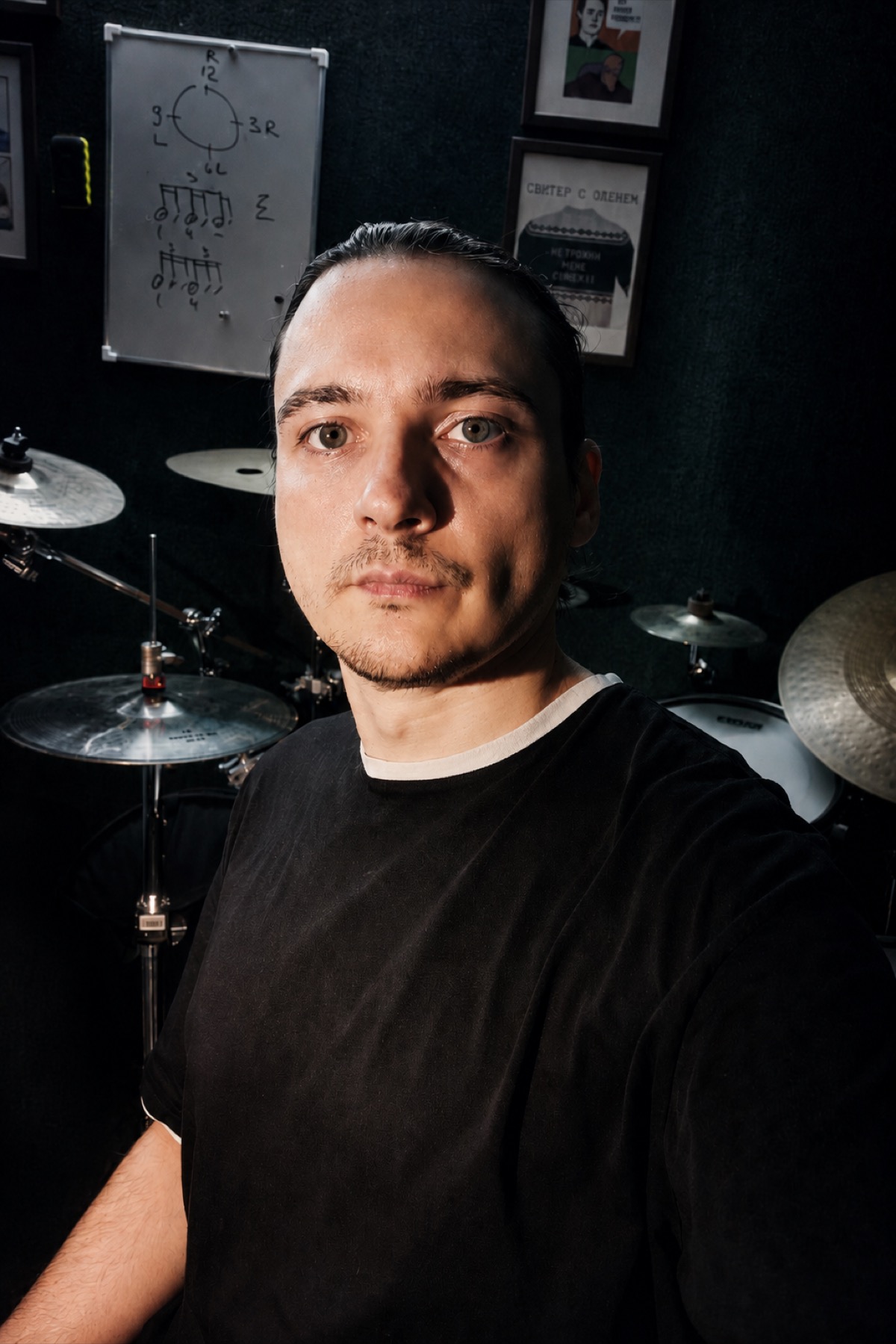
I’m Tony Strotz. I’m a drum teacher, and I’ve been teaching since 2010. Over the years, more than 600 students have studied with me. That number may not sound enormous at first, but there is a reason for it: about 70% of my students stay for a long time, often three years or more. So the turnover is low, and I consider that one of the best indicators of the way I teach. In a typical year I spend around 1,500 hours teaching, sharing my knowledge and experience with people who want to understand the drums more deeply.
About 90% of the students who follow my practice recommendations closely reach a level where they can play in a real band. Not just in a private music-school ensemble, where parts are often simplified until almost anything can be made to work, but in an independent band where they have to hold their own musically.
In my drum lessons, students get clear answers to most of the questions that come up around drum set technique, methods, concepts, and musical application. This knowledge later helps them write their own drum parts once they begin playing with other musicians. It also helps them understand how and why different techniques work in specific musical situations. Learning to hit drums in a sequence is one thing. Developing the taste and control to make even simple ideas sound and feel like music is another level entirely.
Most of my students are people who first pick up drumsticks at our very first lesson. For them, learning the drums starts from zero. Because of that, the system I use has taken shape over roughly ten years, with beginners’ needs at the center. It began with what I learned from my own teachers and from studying the work of respected drum educators around the world. Over time, I also developed my own ways of solving common problems, and I use the approaches that I have found to be the most efficient and practical.
I also often work with students who already play a little. They may understand how simple drum parts are built, but they feel limited: their playing lacks range, depth, or variety. Usually the real issue is a gap in the fundamentals. Filling those gaps is more delicate than teaching someone from scratch. For that reason, I have developed a second way of approaching the basics: one that helps a more experienced student evaluate their own playing honestly. Once a person understands what is missing, the motivation to strengthen the foundation usually appears on its own. If you understand what a material is made of, you also understand where it can be used, how it reacts, and what can be built from it. That is much better than trying to solve every new problem from scratch.
In lessons, we work through techniques and exercises that, with consistent practice, can take you well beyond the level of most casual players. Then we connect that material to real music by analyzing well-known songs that use the same ideas. You can also suggest songs you want to learn. I will help you understand what is being played and what you need to practice in order to play it yourself.
A noticeable number of my students have first tried trial lessons at commercial music schools, or even completed a course there. Later, they realized they wanted a more serious, detailed, and personal approach instead of simply trying the instrument and hanging out. Others had studied with another private drum teacher before taking a break and deciding to continue with someone new. The most common reason they give for choosing my lessons is the presence of a clear system and a step-by-step plan: what we are doing, why we are doing it, and where it leads. Unfortunately, private lessons can sometimes drift into a vague “let’s do this today, for example” format. For a student who does not yet have enough experience to ask the right questions, and who is trusting the teacher to guide them toward a real level of playing, that approach is rarely effective.
My own drum education began with private teachers. At the same time, I earned a degree in education. After that, I studied at the Moscow College of Improvised Music. I would especially like to mention Sergey Borovsky, with whom I studied from 2007 to 2010. He is currently head of the percussion and wind department at the Dargomyzhsky School of Arts in Moscow. I am also deeply grateful to Yuri Balovnev, my drum teacher at MCIM from 2010 to 2013. Their role in my development as a drummer is impossible to overstate.
From 2019 to 2024, I continued my studies with the world-renowned maestro Peter Erskine, an experience I am genuinely grateful for. Any professional musician will tell you that musical growth is a lifelong process.
Alongside teaching, I have also played many concerts at a wide range of venues in Russia and Europe.
These days, my main focus is teaching. I also create educational drum content, which you can find on my Patreon page. My background in both music and education, together with my experience as a drum teacher, helps me approach this work in a structured and productive way, and it is a real pleasure to see how my experience helps new drummers appear and grow.
I would be happy to share that experience with you too.