Drum courses can be built in many different ways. Much depends on what the student wants to understand and what the teacher sees as the most important thing to strengthen at a particular stage: hand technique, coordination, metronome work, stylistic details, building drum parts for songs, or simply feeling freer behind the kit. Each of these areas contains a lot of material that has to be studied carefully and patiently. It is also important to look at what strong contemporary drummers are doing and learn from that.
In this article I will focus on one of the core areas, because it is the basis of my technical drum course. It helps a student gain better control of the instrument, no matter what direction they later decide to study in more detail. One thing is worth saying right away: nobody can reach the same high level in absolutely every area. Each style and each technical subject contains so many details that a lifetime is not enough to perfect all of them. My teachers used to tell me this, and for a while I did not want to agree. Later, when I began to feel how much material stands behind every small piece of knowledge, I had to accept it.
My approach
Over time I came to a simple principle that helps a drummer improve without losing motivation: practice regularly, whatever drum course you choose. Trying to understand everything better than everyone else is a fantasy. Becoming better than you were yesterday is realistic. A serious musician keeps strengthening different skills throughout life.
For a drummer, two of the main areas of work are technique and coordination. This article is about the first one. You will certainly meet people who say that technique is not the most important thing. In one sense, they are right. But if technique is completely absent, learning the instrument becomes much harder than it is for people who treat technique as an important and interesting process. Technique is “not everything” only in the sense that technique alone does not make you the kind of drummer good musicians want to play with. Still, technical work is an essential part of my Drumskill program.
Rudiments
Rudiments matter. Any serious drum school gives them time. They are part of the tradition that has shaped strong drummers generation after generation, so they should not be ignored.
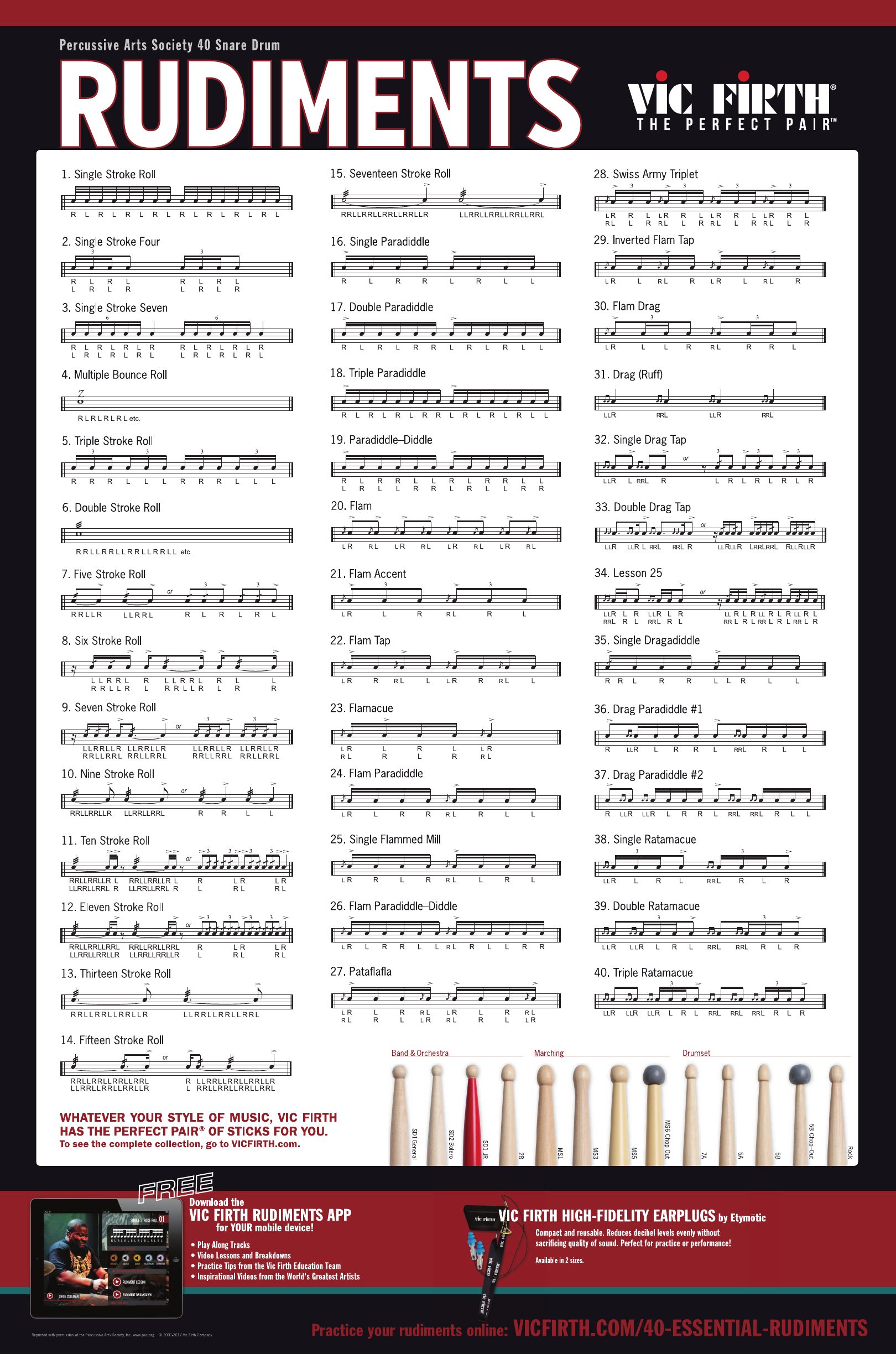
At the same time, rudiments are essentially a set of phrases and sticking patterns that became accepted as standard study material. They can still be played in very different ways: more evenly or less evenly, with better or worse body mechanics, with more or less control, with more or less dynamic range. This is where technique, as I use the word in my rudiment course, becomes central. You can find a lot of information online about the Moeller and Gladstone approaches. They are flexible systems in which strokes flow into one another, helping the drummer make playing more organized, efficient, clear, and physically logical. At higher tempos, in any of these approaches, the way we use stick rebound becomes especially important. Rebound helps reduce the amount of effort needed to play many strokes in a short time.
It also matters whether we are playing single strokes or double strokes. The wrists and fingers work differently in each case. The more time we spend on these details, the finer our control over the sticks becomes, and the cleaner and more varied our sound can be.
Course content
Part one
If I had to make a short list of the most important elements in my technical drum course, it would include the following.
1. Holding the sticks correctly. Controlling them with the whole hand and all the fingers, without over-tightening one part of the hand and while distributing the effort evenly.
2. Controlling the stick height above the drum. This is essential for dynamics, or simply the volume of the strokes. Together with timing, dynamics create the musical feel of what is being played.
3. Stick rebound: creating it, using it, and controlling it. At medium and fast tempos it is much more efficient to let the stick bounce naturally instead of blocking that motion. This also takes serious practice. The pleasure of feeling the sticks do part of the work for you does not come immediately. But anyone who has gone through that process knows it was worth it.
Part two
4. Accents. This subject is so important and so large that it could become a separate course by itself. The Moeller and Gladstone approaches are especially useful here. Each can be applied in different situations. Partly it is a matter of taste, but sometimes one method is clearly more practical than another, depending on the musical context.
5. The push-pull technique. It is not the very first thing a beginner needs, but it can expand the drummer’s speed range, especially when playing doubles.
6. Applying these skills around the drum set. This includes endurance exercises and developing a physical sense of where everything is on the kit. I call this calibration. We also pay attention to the elbows and torso while playing. All of this helps avoid overloading the hands, which already do most of the work.
Each point above includes a whole block of exercises. Every block deserves to be studied separately during drum training. An article can only outline the idea. In lessons, these elements are studied in a specific order and applied at the drum set. My technical drum course is built to guide you through that process in practice.
If you have questions, feel free to send me a message on Instagram.